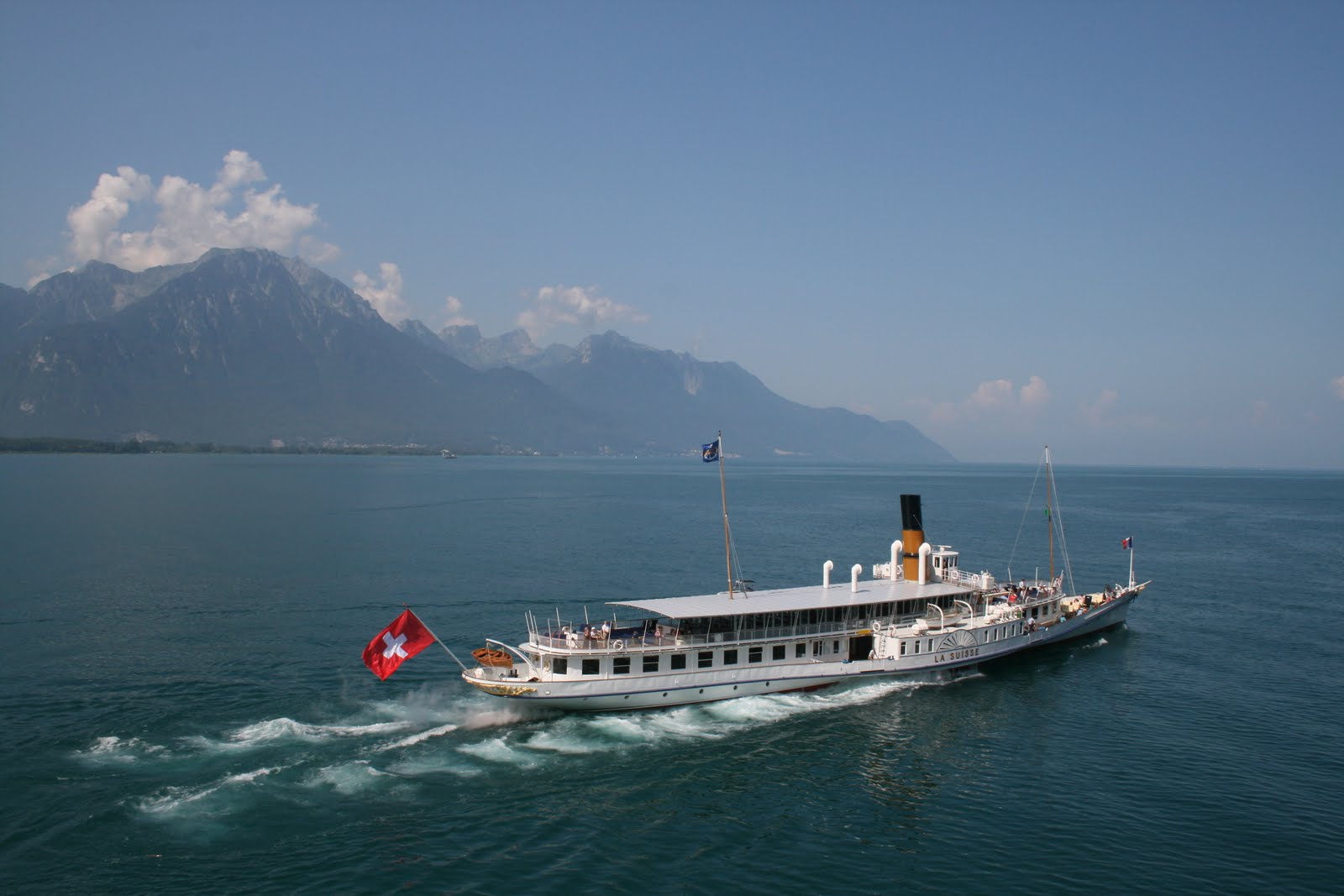
Today we had our very own Swiss national day here in bonny Scotland. Family and friends came to help us gorge our way through lots of Raclette and Bircher Muesli washed down with lovely Swiss wine from the village where our relatives live, as well as a few bottles from elsewhere around the globe. Lorraine and The Lovely G decorated the hall and kitchen and laid the table with special tablecloths, mats and lanterns and other bits and pieces brought back from our short trip a couple of weeks ago.
We found authentic Raclette cheese from Ian J Mellis in Edinburgh and had lots of other cheeses, hams chicken and veggies to grill with our tabletop Raclette set. It's another one of those kind of retro meals, like that other Swiss tradition of fondue, which lends itself to conversation around the table as everyone picks what they are going to have and gets it onto either the top hotplate section to cook or puts in into an individual tray to go under the grill section before sitting back and chatting as the purpose built tabletop cooker does it's stuff.
So, as the afternoon quietly passed, we spent the time eating and talking and having a great time, even taking some time to phone over to Switzerland and speak to the family at their celebration. They're so pleased that we keep the tradition going at this end too.
As usual with a rare family meal, we bought far to much food and have lots of lovely left overs to use up over the next few days. G's brother Leonard was keen to borrow our Raclette set so they could have a party with some of their friends that they ended up taking the set back home to Fife for a while.
I'm lying on the bed. It's late afternoon and The Lovely G and one of her friends are downstairs in the lounge watching a movie on DVD. Lorraine is here staying over and will help us celebrate the 1st August, Switzerland's national day, tomorrow when some of the family come for a special Swiss meal. Lorraine and The Lovely G went to Switzerland together for a short holiday late last year and since then she's been enthusing about all things Swiss to all and sundry, so we have naturally included her in the invite to this years family bash. I've left them to it as I still feel choked with this damned cold and am feeling, if not somewhat antisocial, that I don't want to be around people in case I pass on the dreaded lurgy. My flu has left me with a chesty wheeze which brings coughing fits when I lie down for any length of time.
I too have a DVD on up here and have been engrossed in the film 'Babel' starring Brad Pitt and Cate Blanchet when I become aware that Jess, who has been in the room with me for a companionable couple of hours, is lying watching my chest rise and fall and appears to be listening to the cacophony of wheezing, whistling and low groaning that is coming from me with every breath. My awareness of her has changed the rhythm of my breathing and she now looks back at me. She has what I think is a sympathetic look on her face, although I might be wrong. She is lying on my right a few feet away down the bed, head towards me and her tail contemplatively twitching across the last few inches of its white and ginger tipped length. She slumps over onto her side and stretches both front paws out towards me, arching her back and stretching her spine as she reaches away with her back paws. In front of me her nearest paws spread themselves momentarily and show claws of gleaming sharpness as she yawns in an eye closing movement before twisting her head upside down to gain another perspective of me perhaps. She remains, one front paw stretched towards me, the other crooked back on her chest, tail curled questioningly in mid air, in an almost pantomime catty posture as she watches, watches, watches.
I smile and make a soft noise at her which causes her stretched paw to come even closer as she turns more into an inverted curl, lying on her back. The paw now moves down until it comes in contact with my thigh and, contact made, she pushes gently against the material of my trousers. She begins to purr softly as if to say "You're doing it all wrong! This is how it should sound! It's easy - I can even do it upside down!"
For the last few days, in fact since Saturday evening when the Lovely G and I got home from the meal with Gordon and Charlotte after the air show, I have been suffering from flu. I've been here before, of course. In fact I feel like I have been here much more often since I became unemployed than I ever did when I was working. I genuinely can't recall actually being so ill as to be off work - except for recuperation from a knee op {when in reality I worked from home} - anytime in the last three years.
I almost feel like a fraud. It's like my body has given permission to shut down because it doesn't have a job to maintain or anything more worthwhile to do. While I have been telling myself that looking for work is really important and that I am focused on just that my body has said 'Oh yeah? Well have some of this sunshine.' In the normal course of events - well in my working past that is - I very rarely was ill and if I was, well I just worked through it didn't I. After all I had places to go, people to see and stuff that just had to get done. That was the kind of attitude that also meant that anytime I was on holiday I would invariably end up with a cold or something two or three days into the holiday, as if my body had suddenly cottoned on to the fact that I was on free time and exacted a penalty for ignoring it up till then. Actually, now I think about it I do remember working from home a couple of times when long car journeys didn't seem feasible for whatever reason, but regardless I always ended up still working. Yet for the last few - 5 days now actually - I have been literally floored by this bug and have simply ceased to function on anything other than the most basic level. I feel as weak as a kitten and even Jess - the runt of the litter - could no doubt take me with one paw tied behind her back.
Today though, for the first time in days, I have opened up the laptop and felt able to even think about posting something. I have looked at a few postings from blogs I follow but have been so thoroughly unenthusiastic that I haven't been able to respond to some interesting stuff that's been posted except in a mere one or two almost ignorantly short instances. Even today this damned wee bug has still firmly got me in its grip, perhaps not quite so tightly as two days ago but it sneakily reminds me just how close it still is by sending me on coughing spasms which seem designed solely to remind me just how much pain my rib and stomach muscles can generate, or by sending small barbs of pain into my skull when I simply run my hand down from my forehead and my fingers brush my eyeballs. Whatever this bug has been, it's a doozy! I still cant be more than a few feet away from a box of tissues even if I am using them much less than before and found myself standing in the shower this morning with the shower head adjusted to a concentrated spray and the jet directed straight into my face in an unconscious attempt to massage my aching sinuses. I have taken pills and potions, decongestants and lemony drinks till I'm sure I'm now part lemon myself and even spent the best part of an hour yesterday self inflicting my dreaded childhood treatment of holding my towel covered head over a bowl of steaming water - granted with some olbas oil in rather than the old way of dropping some Vicks vapour rub into the water - all to very little effect.
Even now when I cough or have one of those blooming sneezing fits- ignoring the pain from the ribs - I get tremendous sensations of ringing in my ears and that weird out-of-body/off balance/seeing stars sensation you get where you know that the pressure created has just blown yet another few precious brain cells to smithereens because the normal escape channels are just not doing their job. After the last five days I'm surprised there are still enough of the little blighters still working. Thankfully, for the last two nights I have actually managed to get some sleep - and last night I actually slept better than I do 'normally' surprisingly enough - after three days and nights of sleeping only in short fitful and unhelpful bursts. Also, unusually for me, my appetite has completely crashed and I have survived on a small plate of bran flakes and couple of apples a day {PLEASE let me have lost some weight after all this!!!} At least my digestive tract will be in order hopefully. Actually, just between you and I, there is a definite down side to the last few days diet which has come to the fore, but let's leave it at that shall we?
Now, the sun is shining. I'm going to put on my shades and go and sit quietly on the patio for a moment or two. I'll no doubt be apologising to the local wildlife for my lack of attention over the last few days while I look forlornly at how the grass has grown, knowing that I'm in no fit state to cut it and yet we have visitors coming this weekend and the forecast is for rain over the next two days as well. Will I pick myself up and just get it done?
Friday night my older brother and his wife came to stay over. As can often happen we ended up staying in the kitchen chatting across the whole evening, long after we had finished our meal of hot chicken and pear salad followed by strawberries and blackberries with cream. The two bottles of wine we had opened ran out and we moved comfortably on to coffee until Gordon realised that it was after midnight and he was struggling to stay awake after a hard week at work. So, we cleared away and headed off to bed.
That was close!
In the morning we had a late breakfast as planned and we got our gear together and set off to go to the Scottish Air Museum Airshow at East Fortune, about 20 minutes away from the house. It looked like the weather was going to deteriorate across the day, at least that was the forecast, the best of the weather being in the morning, which was a bit of a worry as the flying demonstrations were to take place across the afternoon. As you can see from the photo's the sky was quite dull but thankfully rain held off for the whole show and only started as we headed off for a bar meal before Gordon and Charlotte set out for home on the other side of the country once again.
Three question marks???
Unfortunately, yet again, I was suffering from the early effects of a head cold which got increasingly worse as the day went on, to such an extent that I was secretly relieved that we were not going to be entertaining again that night. Once we got home I headed off for a hot bath and bed. Sometimes only solitude will do
Well that's us back from a few days away visiting the Swiss relatives. What a fantastic few days it was too. The weather was scorching, the food was good and the company was excellent. You can't ask for more of a short break really, can you?
Side entrance to the house, Beringen.
I'll blog a bit more about it later no doubt, but in the meantime here are a few snaps to be going on with.
Shop display, Stein Am Rhein.
Alinghi - the dancing dog
Old Town Rooftops, Schaffhausen.
See you later.........
Listening to Supertramp, 'Even in the quietest moments'
No entries for a few days as the Lovely G and I are off to a family gathering in Switzerland in celebration of an important family birthday, the return of a family member from a years student exchange in Washington DC and the visit of another far flung family member and her brood from New Zealand.
Blogging will resume shortly........
See you later.
Listening to the Lovely G search for her mislaid sunglasses.......
This {rather unusual for the blog} topic comes from my involvement in child welfare through Scotland's Children's Hearings - lay tribunals - which are able to issue legally binding measures for the treatment, care ,control, guidance or protection of children up to the age of 16 or in certain circumstances 18. These may be children who are offending or being offended against or who are simply in need of some help in facing life's problems in some way that can't be addressed on a voluntary basis, perhaps due to non-engagement by the parents. One of the most common reasons nowadays for a child being brought before a hearing though is because they are deemed to be suffering from a legally defined 'Lack of Parental Care'. These cases are often the most stressful and complicated a hearing has to deal with and can have the furthest reaching consequences.
Every community has them and we've probably all come up against them at one time or other. They're the local family or families that are disruptive, anti-social, engaged in nuisance and criminal activities. Usually they are focused on the female of the household. Often these women are drug or alcohol dependant individuals who have had a long history of failed relationships with transient and violent men, often themselves also drug or alcohol dependant. The family is usually unemployed and dependant on benefits for money. The house and immediate environment are neglected and in poor condition. There can be a relatively high number of children in the household - usually very close in ages and universally troubled in their relationships, chaotic behaviour and attitudes, struggling or failing within the education system, known to the police and social services for offending, for violence against each other and outsiders or lack of parental care. They are not subject to routine or boundaries, they are disrespectful of everyone and can see no further than their own personal needs or gratification. They have adversarial relationships with neighbours and community, with police and social services. Early nuisance and offending behaviours in the children graduate over years to alcohol and drug abuse, violence and gang or weapon - in Scotland this most often means knife - related crime and high incidences of prison time. The family trust no one and feel aggrieved and put upon, distrusting and resistant to any and all attempts at support or intervention. Relationships with wider family - even those parts of the family acknowledged as a valued part of the community are often acrimonious and marked by dispute, chaos or violence at each and every meeting. The families are shunned and isolated by many in the local area.
They are a problem for most communities. They tie up enormous amounts of time, resource and energy from social and emergency services. The impact onto the community and the public purse can be enormous and life-long. They repel and attract elements of society in almost equal measure. Each generation seems to spawn even more disaffected seed to take root and spread the chaos and despair even further afield, increasing criminality and anti-social behaviour in a ripple effect among those easily influenced in the local area. Problems increase with each generation.
But is it nature or is it nurture?
The Impact of Early Environment on Brain Development.
At birth the brain is 25% of adult weight. By age 2 years it's 75% and by ages 3-4 years it is 90% of adult weight. The high level of brain growth and development in these early years is a fundamental reason why babies are totally dependant on the adults around them to meet all their needs for such a long time. The basic architecture of the brain is formed during pregnancy, but at birth the connections between the different parts of the brain aren't yet formed. These connections are predominately relationship/environment dependant for their healthy development which explains the surge of growth after birth. It also highlights the need for an appropriate environment and loving parenting to create a suitable safe and stable platform during the time needed for these brain connections and development to take place.
A child's brain develops sequentially:
Brain stem - this development takes place from pre birth to about 8 months and amongst others controls breathing and organ function.
Mid-brain - which controls the motor function develops between birth and one year.
Limbic Brain - which controls the emotional functioning - develops between six months and two years.
Cortex - which controls reasoning/cognitive functions develops between one year and four years old.
The region for basic vision is completed by age 6 months.
The critical period for developing emotions occurs from ten to eighteen months.
By age two, motor circuits are hard wired.
{The more words a child hears during their second year significantly affects their vocabulary for the rest of their life.}
The acquisition of other functions, such as academic learning takes place over a lifetime but is inherently dependant on the brain development established in these critical early years.
So while this period of brain growth and programming is taking place, what a child experiences and how it experiences is critical for its future. During this period, if a child is frequently exposed to stimulus which generate high levels of stress, or conversely is exposed to a frequent lack of stimulus, the child's brain and emotional development is fundamentally and permanently affected. One effect which is key to this situation is that the brain doesn't learn how to properly control production and reaction to the hormone cortisol. Cortisol is a hormone produced alongside adrenaline, linked to excitement from potentially harmful situations. The body automatically produces these hormones in preparation for 'fight or flight' as a means of self preservation. Cortisol could be described in layman's terms as the fear hormone of the two leaving adrenaline perhaps as the excitement hormone. Because the function of these hormones is to preserve life they are produced instantaneously and they swamp and inhibit almost all other functions while a threat is in place or perceived.
To develop normally the brain has to learn to produce and regulate correct levels of this - and other- hormones. Failure to do so results in significant impact onto the child's life-long abilities.
Where a child is subjected to regular stimulus such as anger or - whether witnessing or directly experiencing - violence, cortisol production is extremely exaggerated and the body is flooded with high levels of the hormone. Where a child is subject to low levels of stimulus through lack of nurturing contact and experiences such as mental and physical stimulus through play cortisol production is absent or minimal. Both these examples have a direct result on how that child will be able to function through its lifetime. It's important also to note that studies have shown that very young children who experience fearful situations respond in exactly the same way every time - producing instantaneous and extremely high levels of cortisol - and do not become normalised to the situation.
Dependent on the history of stimulus the child can therefore develop with extremely high levels of cortisol production in the case of a child in a chaotic environment, abnormally low with extremely high spikes in a neglectful and sometimes chaotic environment and abnormally low levels from a consistent lack of nurture. Children who have these abnormal developmental experiences may have a brain size 20-30% smaller than that of a child who has been reared in a nurturing environment. Impact from this on behaviour can mean that they are shy and anxious and withdrawn, be less sociable and more aggressive than normal children. These children are also more likely to have weakened immune systems and will fall ill more frequently, be more easily fatigued and have disrupted sleep patterns.
Abnormal production of cortisol puts a brake on other body functions, taking priority as its function is linked with survival in dangerous circumstances. It directly reduces relaxation, the immune system and the learning function because the body believes it is in crisis.
When the body is perpetually in a state of crisis it cant easily reabsorb the high levels of cortisol and other systems are permanently weakened, the body, existing in a state of permanent anxiety, has less ability to cope and develops a very quick trigger point to stimulus.
TO PROPERLY LEARN HOW TO REGULATE CORTISOL PRODUCTION CHILDREN NOT ONLY HAVE TO BE SAFE BUT HAVE TO FEEL SAFE.
Feeling safe is all about attachment, establishing a bond of trust and understanding. When this is done correctly it allows the child to learn how to regulate its emotions effectively in a healthy way. Children who can't do this react to actual or perceived stress by producing more cortisol than is healthy and that the body can cope with.
So in answer to the question I posed at the top of this post, It's both nature and nurture.
As you can see, the behaviour of many of these dysfunctional children - who will go on to become dysfunctional adults - is not necessarily a matter of choice but to all intents and purposes has been hard wired into their being by poor parenting with the consequences stated earlier of life-long offending or anti-social behaviour, breeding more generations of similarly affected, poorly parented children.
The big question though is how do we break this damaging cycle and protect future generations of children from damage?
For me it has to be ' save the mother and you will save the generations to come'. We have to solve this problem.
Why?
We are seeing more and more young girls come into the system. They are the mothers of tomorrow who will provide the next brain damaged, violence predilicted generation of offenders .
Perhaps these figures will partly explain more directly;
First though have a look at these two newspaper comments;
"It is depressing nowadays to take up ones newspaper and read the daily catalogue of assaults and murders with knives, razors and other lethal weapons. Indeed slashings and stabbings are becoming so common that they appear to be an accepted part of our modern youths recreation."
{Glasgow Evening Times 1930}
"Across the whole of Scotland it is still knives that account for more than 50% of murders......"
{Daily Record 2008}
So - little has changed in almost 80 years. It's not the modern phenomenon we all think it is!
And is this acceptable?
DEATH BY VIOLENCE PER 100,000
{ranked by country - 2004 figs.}