Don't worry - I'm not thinking of killing any poor avians. I happened on one of those 'On This Day In History' pages which mentioned the battle of Dupplin Moor: a medieval punch-up twixt us and our dear neighbours. I seemed to remember writing about it at one time but couldn't think where.
Found it eventually. It's only the most popular post in the last three years.
So - as I feel a bit lazy today - here it is again:
The story of 'Black Agnes of Dunbar'.
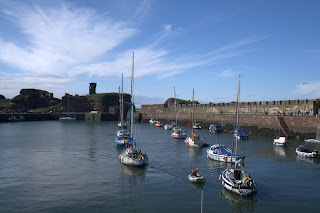
Dunbar Castle today.
Agnes, Countess of Dunbar is well known here in East Lothian for her role in defending Dunbar Castle against an English army in 1338. There's not much left of the castle now but what there is seems to rise fully formed from the red stone of the local area like it's part of the rock itself. In any case what little still remains around the harbour today isn't Agnes' castle of 1338. That earlier stronghold was later 'casttit doune' on order of the king to prevent it falling into enemy hands.
The Celtic Votadini or Gododdin, are thought to have been the first to defend this site, the Brythonic name Dyn Barr, (the fort of the point) is still in use. By the 7th century Dunbar Castle was a central defensive position of the Kings of Bernicia, an Anglian kingdom that took over from the British Kingdom of Bryneich. During the Early Middle Ages, Dunbar Castle was held by an Ealdorman owing homage to either the Kings at Bamburgh Castle, or latterly the Kings of York. In 678 Saint Wilfrid was imprisoned at Dunbar, following his expulsion from his see of York by Ecgfrith of Northumbria. Later, Dunbar was said to have been burnt by Kenneth MacAlpin, King of the Scots. Certainly he is on record in possession of the castle in 879.
Let me describe some background to set the scene that propelled Agnes to her destiny.
By 1338 Scotland was in a chaotic state. Robert The Bruce had been dead almost ten years and his presence no longer blinded its enemies and shadowed the land with confidence, optimism and determination. He'd lived long enough to sign the treaty which recognized him as king of a free country and send it south for an English king's signature and hollow promise of peace in perpetuity. It was carried by a hundred knights on safe-conduct pass to Edward in York, a place they had recently passed through equally safely without such protection. The treaty was ratified by the English Parliament at Northampton but seen by the aristocracy for the capitulation it really was. As part of the peace process, David, The Bruce's five year old son was married to Edward's child sister, Joan, aged seven. Edward too renounced all claim upon Scotland and recognised 'His most dear friend and ally, Lord Robert, by grace of God, King of Scots.' All documents relating to Scotland removed over the previous decades were also to be returned, although it would be 600 years and many sovereigns later before it happened.
{Intriguingly there appears no mention of the Stone of Destiny even though it's hard to believe given its historic importance to Scotlands kings. It would take even longer for that relic to be returned.}
Stone of Destiny under the coronation
throne, Westminster Abbey.
Peace, such as it was, was superficial. It didn't stop cross border raiding by either side. Power in Scotland was in the hands of a Regent - Mar, the young kings cousin - also heir to the throne should the boy-king die. South of the border the exiled King John Balliol's son Edward was receiving tacit royal support and encouragement in his aim of restoration to what he saw as his birthright. He was supported too by those Lords and sons of Lords who had lost lands, titles and influence when Bruce came to power. This eager group, known as 'The Disinherited', were an ideal audience in which to foment rebellion and trouble north of the border to keep the situation unstable and pressure on the troublesome Scots.
The Disinherited and their English allies sailed on 31 July 1332 from several Yorkshire ports to Kinghorn in Fife to get round the terms of the Treaty of Northampton that forbade English forces to cross the River Tweed which at that time marked the border. Moving inland they were met by a Scots force at Dupplin Moor, near Perth. The battle that ensued lasted from dawn until noon and by that time English bowmen, in an early indication of the power and potential of the longbow, had destroyed most of the Scots army, including Regent Mar. . In that gleeful medieval way, it was said that Scots bodies piled up the height of a spear on the field. Victorious Balliol was crowned King at Scone six weeks later, surrounded by the disinherited and many who had previously supported Bruce. He offered the English Edward homage as liege lord and lands in the south which effectively brought England to Edinburgh's doorstep, asking for David's marriage to be set aside so he could marry the young Joan in his place and establish his own dynasty. By December though he was forced to flee half-dressed into the night on an unsaddled horse, back across the border to Carlisle, when a force under Randolph and Douglas, loyal to the boy-king of Scots caught him unprepared at his camp in Annan. King Edward was furious and now openly showed his support for Balliol, claiming the Scots had broken the Treaty of Northampton through their cross border raiding and by raising an English army to invade Scotland once more. Archibald Douglas, younger brother of crusading James, who had thrown Bruce's casketed heart ahead of him before charging to his death among the Saracens en route to bury that same item in the Holy Land, was made new Regent of Scotland until David reached his maturity.
In 1333 Edward came North at the head of an army to take Berwick once again and met the Scots army at Halidon hill, two or three miles north of the town. The Scots had seemingly learned little or nothing from the defeat of Dupplin Moor and now no longer faced the inexperienced boy king who years before had wept in frustration as another Scots army, against overwhelming odds, outwitted him and melted away in the night to live and fight another day. He was now the warrior tactician who, just a few short years in the future, would destroy French chivalric power to win at Crecy, and his army reflected his new understanding of firepower, heavy as it was with men practiced from childhood in the spine crushing discipline of the longbow and the cloth yard arrow, fletched with goose and tipped with steel. The old Scots tactic of the spear tipped 'schiltrom' formation densely packed with men finally proved itself out of time and tragically inadequate.This time Edward had picked an ideal position and there would be no mistakes allowing the enemy to escape. As the Scots ranks attacked in their lumbering hedgehog formations that windy morning they began to slip on the grassy slope even before clouds of arrows were driving into them. It was said that the onslaught of the bowmen was so fierce that the Scots turned their heads as if walking into sleet. When finally they broke and ran, death rode close behind, armour clad with steel mace or sword at the ready. The notion of confidence, of invulnerability, which had been Bruce's hard won legacy was gone.
It had lived less than a lifetime.
Schiltrom fighting
For Edward, it was the kind of victory that his long legged Grandfather would have been proud of. It was vindication of his tactics and bloody rehearsal for victories yet to come. For the Scots it was utter disaster. Those Barons quick enough to find a fast horse and flee the field, quickly sent the boy king and his queen to France and the protection of its king before heading for the hills or throwing themselves at the dubious mercy of Edward and Balliol. Scotland lost 5 Earls, 70 Barons, 500 knights and countless thousands of spearmen. The English lost virtually no-one. Records show their losses at 14, a dozen of them archers. With the loss of its army, Scots resistance returned to the old ways of guerrilla tactics, isolated strongholds and lightning raids from the wilderness. For the next twelve years there would be no peace, but a virtual civil war as Regent after Regent resisted the usurper Balliol in the name of King David.
It was this world that Black Agnes inhabited.
Agnes Randolph, Countess of Dunbar, was the daughter of the Earl Of Moray, one of Bruce's most loyal supporters, who had fought beside his king at the Bannock-Burn and other places. Her husband, Patrick, Earl of Dunbar and March { the border lands were called 'Marches'} was also of royal blood and a supporter of David II. The vulnerable and volatile border lands needed a trustworthy hand and a strong sword arm. The Dunbar's epitomise a loyal and trustworthy pedigree of support for David in the trying times of his exile. In 1338 Earl Patrick was absent from his lands fighting for the cause in the north. Agnes was left in control of the stronghold of Dunbar castle with a skeleton force and her retinue of servants. In those days this was no unusual thing but it is more noticeable for the fact that she was left during such dangerous times. This may be an indication that it was felt Dunbar was the safest place or that there was no-one capable enough, or trustworthy enough, to be left in her stead. History would show that it was indeed fortunate that Lady Agnes and no other was in charge at the time. She's come down the years known as Black Agnes, perhaps from the jet-black of her hair or from the combination with her olive coloured skin. Both were noted. Both are possible, but we don't know for sure. What we do know is that in January of 1338 Lord Montague, Earl of Salisbury, an experienced soldier, arrived at Dunbar with an English army and instructions to take the castle. He was in high spirits and felt sure that he would be a match for the Lady Agnes. In that belief he would find himself sadly mistaken.
Asked to surrender the castle, Agnes declined, reputedly stating,
"Of Scotland's King I haud my house, He pays me meat and fee, And I will keep my gude auld house, while my house will keep me."
Pleasantries over, the siege began in earnest with an extended bombardment by catapults. During three weeks of almost continuous assault, Agnes showed her contempt for Salisbury's efforts by walking the battlements between salvos, her retinue of ladies in waiting dressed in all their finery, all ostentatiously dusting off the damage done by the English missiles with handkerchiefs of white linen to indicate that it was no more than a minor inconvenience. It's easy to imagine Lord Salisbury's reaction. No matter when he attacked, Agnes was prepared, her small force ready to act. This was recorded later in ballad form as if from his own mouth,
"She makes a stir in tower and trench,
That brawling, boisterous, Scottish wench;
Came I early, came I late.
I found Agnes at the gate."
Agnes was an early master of one-upmanship. Faced with her captured brother being brought to the castle by the English, a rope around his neck, she answered their threat to hang him before her eyes by telling them to do so as she would then inherit his lands and titles. {Her brother was not hanged but taken away to custody in England.} On one occasion she narrowly missed capturing Salisbury himself, leading an attempt to gain entry to the castle - having bribed the gatekeeper - who in turn advised Lady Agnes. Instead she sprang the trap too soon and shut the portcullis down on an attendant instead, but sent caustic word to Salisbury later that evening that 'she had hoped to dine with him and was sorry to have missed him.' Salisbury responded by sending for a huge siege engine called 'The Sow', a battering ram with a wooden roof. He attacked the castle entrance only for Agnes to destroy it before any damage had been done by dropping, from the ramparts, a huge rock previously fired into the castle by English catapults. It went through the roof of 'The Sow' killing many of the men who were operating it. In yet another episode she had Salisbury targeted by a bowman at range and only narrowly missed him, striking and killing the man at his side.
Even the English quipped admiringly, "Black Agnes' love-shafts go straight to the heart!".
Salisbury continued to besiege Dunbar for five months by which time things were desperate and starvation was near. Hope came when a small force from the castle on Bass Rock managed to get supplies through the naval blockade by disguising themselves as fishermen returning to port. With typical crushing mockery Agnes sent Salisbury a fresh baked loaf of bread and a bottle of fine wine. By this time Edward's attention was elsewere and he was beginning to cast his eye at France. This new focus caused him to relocate forces in support , leaving Balliol to manage Scotland as best he could. By June 10th Salisbury was ordered to lift the siege and left in disgrace. His nemisis would go down in Scots history as Black Agnes of Dunbar.
Even hundreds of years later Agnes is recognised by many in Scotland as a true heroine and an inspirational leader. Her name and values were used several centuries later to rally support and inspiration in the name of the womens suffrage movement in the early years of the twentieth century.
She was voted in the top 100 in the millenium list of influential Scots.
Our friend M came up to the house this morning to sort out a problem with some lights at the house {pure hopeless at electricity, me} and commented how nice it was here compared to Dunbar where the sea haar {mist} has come in with the humidity from the good weather we've been experiencing these last few days. Their house is a couple of hundred yards from the sea and he said that he could barely see from one end of the garden to the other and had been quite chilled while we are basking in glorious sunshine here.
Once he'd successfully sorted our little problem {cheers mate by the way!} he mentioned he had some wood he was about to clear out of his shed so I volunteered to come and take it off his hands as we could use it to fuel the chiminea we have beside the patio. It's nice to sit out on a clear but chilly evening and be comforted by the heat from this wood burning stove while a few glasses of nice wine help us send the evening off in quiet contemplation or conversation. Soon after he departed I got ready to go down to Dunbar to pick up the wood and headed off after him. Less than a mile down the road the strands of haar were trailing off the fields and across the road and by the time I'd gone another mile I had to put on lights to drive - at mid-day!
I remember the haar well from the years we spent living down in Dunbar before we moved a few miles along the coast to where we are now and it was something I always hated. While the rest of the coast benefits from clear skies and sunshine, so often Dunbar is shrouded in sea-mist. This thick cloying haar can sometimes last for three weeks at a time, which is frustrating when you know that just a couple of miles away people are basking in the warmth of the sun, enjoying the fabulous views hereabouts and getting a nice little tan. By the time I'd arrived at M's house the temperature gauge in the car had plummeted from 16c to only 8c and I felt the chill immediately on stepping out of the car. While normally happy to stand around a while and chat or drink his coffee I was single minded today in my determination to get the wood into the back of the car and get back home. I may not be a good gardener. I may not even particularly like gardening, but I was glad to get back into the car and head home away from the damp and the chill of 'Sunny Dunny'.
I don't like to gloat but I had a huge smile on my face when I suddenly drove out of the haar again when I was almost back home. I turned off the lights on the car, rolled the window down, cranked up the music and watched the thermometer climb steadily upwards. Oncoming traffic - if they saw me at all - probably thought the car was being driven by a lunatic grinning away for no reason.
But now, cold cider freshly poured, the garden calls and for once I'll be only too happy to pull a few weeds or wander round with the lawn mower for an hour or two with the sun on my back. I'll be happy to spray the drive with weedkiller, rake some moss and above all enjoy an afternoon in the sun and a cider or two. Heck I may even risk bringing Jess out on her leash and tie her to one of the apple trees so she can lie in the shade, flick her tail and dream of chasing the young braves of the local sparrow squadron.
This afternoon turned into a nice sunny few hours, so different from the dull and monochrome morning it had started out, so the Lovely G and I decided to flee the coop for an hour or two and head out for a walk. On Saturday I had suggested that if the day was good enough today we would go to North Berwick and have a walk through the town and out onto the rocks at the end of the harbour, with perhaps a stop off somewhere nice for a coffee, but as we were leaving later than expected I suggested - rather than drive the half hour to North Berwick - we change plans and just take a beach walk at Dunbar as Belhaven has a good stretch of sand along the bay and in sunny weather like this there are some great views out to The Bass Rock etc. Me being me, I took the camera along so here are some photo's taken while we were out.
I posted another photo of this ' Bridge to Nowhere' last week. This one shows its true purpose - spanning a burn {stream} flowing into the bay here.
North Berwick Law in the distance.
Law is an old Scots word for hill and N.B. Law, one of several volcanic plugs in the area, stands over the town - a great viewpoint.
'Look what I found Mum'
The local surf school uses the bay here for practice and training.
The Bass Rock with the coastline of Fife about 8 miles behind across the estuary
Getting ready for home.
Lost feather - or unwanted gift for a cowardly surfer?
'This way's better Dad'.
We took the back roads home. This from the top of Spott hill.
The soil around us here is red - dramatically so at times.
Distant Dunbar.
See you later.
Listening to The Hollies, 'The Air That I Breathe'
There's a grey morning being freed from the remains of night-time as The lovely G and I set out for the journey to Dunbar and her train to Edinburgh this morning. The hedge along the drive dances as we pass by in a wind not far short of howling but the drive is uneventful except for the advance notice signs of roadworks that are going to slow us down over the next month being set up a mile from the village. We get to the station in good time and G, who has been away for a few days so this is her first day back at work, looks at me with an 'Oh God' kind of look on her face, knowing that work has piled up while she has been away yet she has a full day of appointments which won't allow her to make contact with anyone leaving messages for her unless she skips lunch to cram a few calls in. This is a frequent feature of her employment now it seems.
I leave her with a hug and a look that tries to say I sympathise with her and the struggle she is going to have today. We've arranged that I'll come and meet her to go to the cinema after work so hopefully that small thing will give her something to look forward to at the end of the day's slog. {I'll have to be careful not to do my usual falling asleep routine which has become such a feature of my middle aged cinema experience. That won't go down well if she's had a hard day yet it's me who nods off at the first opportunity.}
I stop at a local shop to buy my morning 'Hootsman' newspaper and some milk and head back home. The smoke from the chimney of the cement works is flat against the sky as I pass and looks like a rag stretched out by the wind. A thick grey streak nailed firmly at 90 degrees, it could have been drawn by a child. Towards Torness Power Station the view opens out and I see Grey, Grey, Grey: sky, sea and headland all merge and the road that takes me toward them all is as grey as the rest. I drive and think grey thoughts.
Taking the side road back to the village I come round a corner and see the matronly silhouette of a hen pheasant running across the road, skirts hitched to show her skinny legs. I catch sight of her just in time to hit the brakes but even so she takes to indignant wing to get completely out of the way and in my mind she departs with an unfairly disparaging view of my driving ability. That's life I suppose. I watch her leave and return my attention to the road, keeping a wary eye out for more of her kin by the foot of the hedges that line my route back home but thankfully no more local wildlife seems tempted to test my reflex versus braking distances and the rest of the journey is safely over a few minutes later.
The garden hedge is still dancing madly away when I pass by again and finally pull up at the side of the house. The light from the kitchen door looks inviting and I'm ready for a coffee as I close the car door behind me and step up to the patio door and into the warmth.
The morning is still grey but somehow, my mood no longer is.
see you later.
Listening to Lady Gaga 'Bad Romance' - which makes me think of this........
On the wall at the side of the bed is a painting by Patricia Sadler, a local lady with a talent for colour which shows in her wonderful paintings of flowers. The painting across from me and which I see as I wake almost every morning isn't one of her flower paintings though. It's a small painting about twelve inches by twelve, framed in a broad, gold painted frame, of the beautiful little harbour at Cove, a mile, maybe a little more, from the house. It's an impression of the harbour from above, corn gold grasses and stone coloured walls frame waters painted deep in the colours of summer. It often puts a smile on my face as I wake up and it's often the last thing I look at before putting off the bedside light. It's familiar and comforting both as an object and as an aide memoir of a lovely spot which is just what you want as you put your head down on the pillow. I think so anyway!
The Lovely G and I found it tucked away in a corner of a tiny little art gallery on the west coast of England a few years ago. As I often do, I'd wandered away on my own after a bit to explore the gallery which was an old house with lots of nooks and crannies. I turned into what I thought was a corridor to find it was in fact an ancient and blocked off doorway to another part of the house. The painting of Cove was on the wall there where the door should have been, instantly recognisable and completely unexpected. I knew as soon as I saw it that it would be coming home with us. It was so out of context where it was, as if it had been put there because the gallery owner had nowhere suitable to put it or thought no-one would want to buy it. It was the only painting of Patricia's in the gallery and the only one in that style I remember. It was strange to bring it back to where it had started life as an idea in the head of someone we know and who's work hangs here and there around the house.
It certainly took the long way home.
Cove Harbour Today.
The Lovely G and I enjoy Cove with its confusing combination of proximity yet solitude. It feels a timeless spot. There are only a couple of small boats working out of the harbour nowadays, mostly creel fishermen with lobster-pots and the like working the coastline up toward Dunbar and down to Eyemouth. Just small scale like it always was. The harbour, now privately owned and managed, offers good protection tucked away at the bottom of the steep slopes and surrounding cliffs In bygone days Cove gave its shelter to the boats belonging to the families of the hamlet that shares its name at the top of the cliff . It made an ideal base for smuggling and plenty of illicit contraband has been hauled up the path to the top of the cliff and away or been hidden temporarily in the side passages of the tunnel cut through the headland.
The hamlet of Cove was never a big place and, sitting proud near the edge of the cliff, is often cruelly exposed to the elements. There is a poignant little memorial to the loss of the men of Cove in the great storm of 14th October 1881 when many fishing communities on this part of the coast were devastated. The memorial sculpture shows the widows and children left behind looking out to the sea for the return of their men. Cove was the worst hit community proportionately, losing four of its five boats and 11 of its 21 fishermen.
Cove Memorial
It makes it easy to understand why even now the lifeboat and RNLI is such a big thing locally even when the numbers of fishing boats has declined and pleasure boats have taken over the harbour at Dunbar. Especially as we head towards the colder parts of the year.
Agnes, Countess of Dunbar is well known here in East Lothian for her role in defending Dunbar Castle against an English army in 1338. There's not much left of the castle now but what there is seems to rise fully formed from the red stone of the local area like it's part of the rock itself. In any case what little still remains around the harbour today isn't Agnes' castle of 1338. That earlier stronghold was later 'casttit doune' on order of the king to prevent it falling into enemy hands.
The Celtic Votadini or Gododdin, are thought to have been the first to defend this site, the Brythonic name Dyn Barr, (the fort of the point) is still in use. By the 7th century Dunbar Castle was a central defensive position of the Kings of Bernicia, an Anglian kingdom that took over from the British Kingdom of Bryneich. During the Early Middle Ages, Dunbar Castle was held by an Ealdorman owing homage to either the Kings at Bamburgh Castle, or latterly the Kings of York. In 678 Saint Wilfrid was imprisoned at Dunbar, following his expulsion from his see of York by Ecgfrith of Northumbria. Later, Dunbar was said to have been burnt by Kenneth MacAlpin, King of the Scots. Certainly he is on record in possession of the castle in 879.
Let me describe some background to set the scene that propelled Agnes to her destiny.
By 1338 Scotland was in a chaotic state. Robert The Bruce had been dead almost ten years and his presence no longer blinded its enemies and shadowed the land with confidence, optimism and determination. He'd lived long enough to sign the treaty which recognized him as king of a free country and send it south for an English king's signature and hollow promise of peace in perpetuity. It was carried by a hundred knights on safe-conduct pass to Edward in York, a place they had recently passed through equally safely without such protection. The treaty was ratified by the English Parliament at Northampton but seen by the aristocracy for the capitulation it really was. As part of the peace process, David, The Bruce's five year old son was married to Edward's child sister, Joan, aged seven. Edward too renounced all claim upon Scotland and recognised 'His most dear friend and ally, Lord Robert, by grace of God, King of Scots.' All documents relating to Scotland removed over the previous decades were also to be returned, although it would be 600 years and many sovereigns later before it happened.
{Intriguingly there appears no mention of the Stone of Destiny even though it's hard to believe given its historic importance to Scotlands kings. It would take even longer for that relic to be returned.}
Stone of Destiny under the coronation
throne, Westminster Abbey.
Peace, such as it was, was superficial. It didn't stop cross border raiding by either side. Power in Scotland was in the hands of a Regent - Mar, the young kings cousin - also heir to the throne should the boy-king die. South of the border the exiled King John Balliol's son Edward was receiving tacit royal support and encouragement in his aim of restoration to what he saw as his birthright. He was supported too by those Lords and sons of Lords who had lost lands, titles and influence when Bruce came to power. This eager group, known as 'The Disinherited', were an ideal audience in which to foment rebellion and trouble north of the border to keep the situation unstable and pressure on the troublesome Scots.
The Disinherited and their English allies sailed on 31 July 1332 from several Yorkshire ports to Kinghorn in Fife to get round the terms of the Treaty of Northampton that forbade English forces to cross the River Tweed which at that time marked the border. Moving inland they were met by a Scots force at Dupplin Moor, near Perth. The battle that ensued lasted from dawn until noon and by that time English bowmen, in an early indication of the power and potential of the longbow, had destroyed most of the Scots army, including Regent Mar. . In that gleeful medieval way, it was said that Scots bodies piled up the height of a spear on the field. Victorious Balliol was crowned King at Scone six weeks later, surrounded by the disinherited and many who had previously supported Bruce. He offered the English Edward homage as liege lord and lands in the south which effectively brought England to Edinburgh's doorstep, asking for David's marriage to be set aside so he could marry the young Joan in his place and establish his own dynasty. By December though he was forced to flee half-dressed into the night on an unsaddled horse, back across the border to Carlisle, when a force under Randolph and Douglas, loyal to the boy-king of Scots caught him unprepared at his camp in Annan. King Edward was furious and now openly showed his support for Balliol, claiming the Scots had broken the Treaty of Northampton through their cross border raiding and by raising an English army to invade Scotland once more. Archibald Douglas, younger brother of crusading James, who had thrown Bruce's casketed heart ahead of him before charging to his death among the Saracens en route to bury that same item in the Holy Land, was made new Regent of Scotland until David reached his maturity.
In 1333 Edward came North at the head of an army to take Berwick once again and met the Scots army at Halidon hill, two or three miles north of the town. The Scots had seemingly learned little or nothing from the defeat of Dupplin Moor and now no longer faced the inexperienced boy king who years before had wept in frustration as another Scots army, against overwhelming odds, outwitted him and melted away in the night to live and fight another day. He was now the warrior tactician who, just a few short years in the future, would destroy French chivalric power to win at Crecy, and his army reflected his new understanding of firepower, heavy as it was with men practiced from childhood in the spine crushing discipline of the longbow and the cloth yard arrow, fletched with goose and tipped with steel. The old Scots tactic of the spear tipped 'schiltrom' formation densely packed with men finally proved itself out of time and tragically inadequate.This time Edward had picked an ideal position and there would be no mistakes allowing the enemy to escape. As the Scots ranks attacked in their lumbering hedgehog formations that windy morning they began to slip on the grassy slope even before clouds of arrows were driving into them. It was said that the onslaught of the bowmen was so fierce that the Scots turned their heads as if walking into sleet. When finally they broke and ran, death rode close behind, armour clad with steel mace or sword at the ready. The notion of confidence, of invulnerability, which had been Bruce's hard won legacy was gone.
It had lived less than a lifetime.
Schiltrom fighting
For Edward, it was the kind of victory that his long legged Grandfather would have been proud of. It was vindication of his tactics and bloody rehearsal for victories yet to come. For the Scots it was utter disaster. Those Barons quick enough to find a fast horse and flee the field, quickly sent the boy king and his queen to France and the protection of its king before heading for the hills or throwing themselves at the dubious mercy of Edward and Balliol. Scotland lost 5 Earls, 70 Barons, 500 knights and countless thousands of spearmen. The English lost virtually no-one. Records show their losses at 14, a dozen of them archers. With the loss of its army, Scots resistance returned to the old ways of guerrilla tactics, isolated strongholds and lightning raids from the wilderness. For the next twelve years there would be no peace, but a virtual civil war as Regent after Regent resisted the usurper Balliol in the name of King David.
It was this world that Black Agnes inhabited.
Agnes Randolph, Countess of Dunbar, was the daughter of the Earl Of Moray, one of Bruce's most loyal supporters, who had fought beside his king at the Bannock-Burn and other places. Her husband, Patrick, Earl of Dunbar and March { the border lands were called 'Marches'} was also of royal blood and a supporter of David II. The vulnerable and volatile border lands needed a trustworthy hand and a strong sword arm. The Dunbar's epitomise a loyal and trustworthy pedigree of support for David in the trying times of his exile. In 1338 Earl Patrick was absent from his lands fighting for the cause in the north. Agnes was left in control of the stronghold of Dunbar castle with a skeleton force and her retinue of servants. In those days this was no unusual thing but it is more noticeable for the fact that she was left during such dangerous times. This may be an indication that it was felt Dunbar was the safest place or that there was no-one capable enough, or trustworthy enough, to be left in her stead. History would show that it was indeed fortunate that Lady Agnes and no other was in charge at the time. She's come down the years known as Black Agnes, perhaps from the jet-black of her hair or from the combination with her olive coloured skin. Both were noted. Both are possible, but we don't know for sure. What we do know is that in January of 1338 Lord Montague, Earl of Salisbury, an experienced soldier, arrived at Dunbar with an English army and instructions to take the castle. He was in high spirits and felt sure that he would be a match for the Lady Agnes. In that belief he would find himself sadly mistaken.
Asked to surrender the castle, Agnes declined, reputedly stating,
"Of Scotland's King I haud my house, He pays me meat and fee, And I will keep my gude auld house, while my house will keep me."
Pleasantries over, the siege began in earnest with an extended bombardment by catapults. During three weeks of almost continuous assault, Agnes showed her contempt for Salisbury's efforts by walking the battlements between salvos, her retinue of ladies in waiting dressed in all their finery, all ostentatiously dusting off the damage done by the English missiles with handkerchiefs of white linen to indicate that it was no more than a minor inconvenience. It's easy to imagine Lord Salisbury's reaction. No matter when he attacked, Agnes was prepared, her small force ready to act. This was recorded later in ballad form as if from his own mouth,
"She makes a stir in tower and trench,
That brawling, boisterous, Scottish wench;
Came I early, came I late.
I found Agnes at the gate."
Agnes was an early master of one-upmanship. Faced with her captured brother being brought to the castle by the English, a rope around his neck, she answered their threat to hang him before her eyes by telling them to do so as she would then inherit his lands and titles. {Her brother was not hanged but taken away to custody in England.} On one occasion she narrowly missed capturing Salisbury himself, leading an attempt to gain entry to the castle - having bribed the gatekeeper - who in turn advised Lady Agnes. Instead she sprang the trap too soon and shut the portcullis down on an attendant instead, but sent caustic word to Salisbury later that evening that 'she had hoped to dine with him and was sorry to have missed him.' Salisbury responded by sending for a huge siege engine called 'The Sow', a battering ram with a wooden roof. He attacked the castle entrance only for Agnes to destroy it before any damage had been done by dropping, from the ramparts, a huge rock previously fired into the castle by English catapults. It went through the roof of 'The Sow' killing many of the men who were operating it. In yet another episode she had Salisbury targeted by a bowman at range and only narrowly missed him, striking and killing the man at his side.
Even the English quipped admiringly, "Black Agnes' love-shafts go straight to the heart!".
Salisbury continued to besiege Dunbar for five months by which time things were desperate and starvation was near. Hope came when a small force from the castle on Bass Rock managed to get supplies through the naval blockade by disguising themselves as fishermen returning to port. With typical crushing mockery Agnes sent Salisbury a fresh baked loaf of bread and a bottle of fine wine. By this time Edward's attention was elsewere and he was beginning to cast his eye at France. This new focus caused him to relocate forces in support , leaving Balliol to manage Scotland as best he could. By June 10th Salisbury was ordered to lift the siege and left in disgrace. His nemisis would go down in Scots history as Black Agnes of Dunbar.
Even hundreds of years later Agnes is recognised by many in Scotland as a true heroine and an inspirational leader. Her name and values were used several centuries later to rally support and inspiration in the name of the womens suffrage movement in the early years of the twentieth century.
She was voted in the top 100 in the millenium list of influential Scots.
Following on from this mornings post about the weather, here's a link to some photos of the effects of the storm on Dunbar from local photographer Billy Main. These ones are taken yesterday.
That's what they say about March normally anyway.......
Hullo ma wee blog,
This mornings trip to Dunbar for the lovely G's train to work started earlier than normal, planned after last nights storm delayed return from work, taking into consideration the flooding already becoming problematic on the A1 past Torness power station at 7pm on the road home.
I listened to the hooligan wind screaming around the house last night from the warmth of bed thinking that I couldn't remember worse in the 8 years we have been here. I woke several times across the night yet wasn't tempted to follow my nocturnal habit, to head for the kitchen and night time comfort of coffee and blogging, happy for once to stay comfortably imprisoned by the several hundred banshees at the window and their howled demands to be let in. The wind kept me awake as the house creaked and groaned in her fight to keep us sheltered and my thoughts were swept in many directions but always, always came back to shrieking Mother Nature angrily demanding my attention. Jess, determinedly shouldered deeper into the duvet at our sides as she found her own ways of communing with sleep. Easy for a cat. The lovely G slept easily too. {I have often thought she may be part cat herself}. Eventually, as she does, sleep quietly claimed me and took me through to an early rise.
It was clear that things hadn't changed for the better as I peered out at the dark and the gloom this morning. Mother Nature still in angry voice, the trees in the garden shaking hard to loosen night from their shoulders, rain beating against the front of the house and, barely seen across the garden and drive, our enormous hedge swaying and twisting in the melee like some wild, threatening wall of malevolence straining to break free of the earth and launch itself in a suicidal charge at the house. I shuddered and made an unusual-for-me plan to head back to bed after the trip to the station, to seek comfort and solace in warmth for an hour or so. After all, I don't intend to spend much time out in that if I can avoid it.
By the time we were ready to leave for our journey, inky dark had turned hard grey, the added light doing nothing to make the scene beyond the window pane any more inviting. Suitably bundled in protective clothing we made eyes at each other as I opened the door and we stepped out to drive and car, immediately assaulted by a face full of wind and rain that stung and took the breath away, sharp intake of icy cold and a wince at stinging cheeks, loud exclamations as we slammed car doors shut against the reality of the day.
We ploughed through the flooded bottom of the drive and emerged onto the rain and wind scoured road, were blown up the hill and out of the village, the sea barely discernible from my favourite viewpoint on the crest of the hill. The car was being buffeted like I have never felt before. You see programmes on extreme weather on TV and this could have had its own slot. The A1, as we joined it, was eerily quiet and I immediately thought that a mile or so ahead we would be faced with blue lights and barricades closing off the section of the road most prone to flooding by muddy water off the fields on either side of the road, as it sometimes is, but surprisingly as I coaxed the car on we met nothing like that. The road which I fully expected to be 'hoodlum' with water was difficult for sure, but passable with care, the road in that section thankfully sheltered from the worst of the wind. The car continued to be pounded by wind and water as we drove on and at times I thought I was actually in a boat, the way the car was pitching. I have never driven in conditions like we met on the most exposed mile or two along the coast, and found myself thinking of lorry drivers until I looked at the sea in the increasing light. It was literally almost indescribable in its violence and seeming intention to wipe the land from its face. Normally this is a placid coast, but sea anywhere can be vicious at times. I thought I had seen all its faces until this morning. It was truly frightening and I uttered an ' Oh my God' to the lovely G beside me and turned my thoughts to any out at sea in that terrible storm and for the lifeboatmen who are a treasured part of our communities hereabouts.
The radio told of countrywide storms, lorries jack-knifed and overturned, multiple accidents, roads closed through flood and fallen trees, of snow so heavy that power lines had come down across Northern Ireland as we carried carefully on our way through roads unusually quiet of traffic, our headlights probing the gloom to show sparkling rain blown horizontally across our path or crashingly head on into the windscreen. A morning of biblical proportion. I dropped G off at the station to find cancelled trains replaced by emergency bus services which would considerably lengthen her journey to work. Despite an offer to drive her on to Edinburgh I was dispatched homeward with a kiss and a 'thanks for getting me here'. A stop for my morning 'Hootsman' newspaper saw me bent almost double in the wind tunnel of Dunbar main street, battered by rain between shop and car. The return journey as eventful as before with the wind at my back occasionally threatening to jolt me into oncoming traffic, or so it seemed, until I turned once more up the drive to the house and its comfortable warmth and companionable cat sitting patiently at the french doors looking askance at the lack of birdlife so necessary for a felines perfect contemplation of day.
As I stepped from the car I lowered my head against the wind for the few steps to sanctuary and received a final benediction of driven rain turned sleet on the top of my head.
March......
In like a lamb and out like a lion more like.......
It's a beautiful day. This mornings drive to Dunbar station with The Lovely G was the first time this year I had not used lights on the car for the journey. Although it was a nose tingling -2C, and with a wind behind it making it feel even more biting, the sky was clear and pastel blue. Once the car had heated up you could almost imagine that it was a summers morning, with the exception of the trees all around being bare of leaves.
After dropping G at the station I took time, on the spur of the moment, to go down to the harbour and spend just a few moments walking round and enjoying the light and the air, despite the cold reminding me just how spur of the jacketless moment it had really been. Despite that, the view all the way across the estuary to a sunny Fife coastline and the fantastic colour of the castle ruins, red in the rising sun, was almost as invigorating as the lack of temperature, with a pale blue sea set underneath that pastel sky and the gentlest of swells moving the surface. I watched some seabirds afloat near the harbour walls before turning, envious of their complete disregard for the cold, taking a deep breath of icy air and heading briskly back to the car and its retained warmth. I felt almost purified, but that might just have been icicles in the brain.
By the time I had turned onto the A1 again for the drive home, my shivering had stopped and body temperature had reached a more comfortable sense of proportion. I was able once more to appreciate what a fantastic start to March we've been given. The snows of February easily forgotten, I felt like it was the first time this year that I could really see the green of the grass in roadside fields, notice that sometime recently a farmer must have created a newly ploughed field of red Dunbar earth, and how little left of the winter feed the herds of sheep had left to them in stubble strewn pastures near the village. As the car climbed over the crest of the hill at the edge of the village, a few hardy, but well insulated, souls were completing the obligatory early morning walking of winter wrapped dogs. As I pulled past them into the drive and scrunched across ice covered puddles I was already thinking of coffee and remembered with an eager smile, the two large croissants left from Sundays solitary breakfast. That will do very nicely, thank you very much.
It's a beautiful day......
see you later.
listening to Mott The Hoople 'All the Young Dudes'
6.00am this morning: I had been awake for a while, not long but maybe 10 minutes. Instinctively, still half asleep I had been yawning and stretching under the covers, rubbing my eyes and wiping the palm of my hands from forehead to chin as I stroked myself out of sleep. Having gone to bed at 2.00am, that's not bad for me but the lovely G, facing her 6th day at work this week and still struggling to contain a cold that has dogged her across most of the preceding week turned to me and said,
"Please, get up. Give me just another 15 minutes of peace before I have to get up too."
Aware now of my inconsiderate behaviour I apologised and got out of bed straight away and went out to the hall where I dressed, groggily and oddly in the dark, stuck bare feet into slippers before heading down to the kitchen where I pressed the on switch of the laptop on my way to kettle and coffee. A fill of the kettle and a wander back to the laptop to tap in the password meant that by the time I returned to my familiar chair at the kitchen table, in the corner by the patio door, coffee cup in hand I was ready to switch on my morning radio station and go to the blog dashboard to see who had posted overnight or if anyone had dropped a comment to be published.
In the next few minutes I followed whats become pretty much my morning routine of blog checking, saying hello to Jess and making a fuss for a moment or two, of changing the litter tray and checking food and water are there and taking milk and butter from the fridge in preparation for breakfast porage or whatever takes my fancy from our stock of cereal. All totally mundane and familiar to many millions nae doubt. I often find I have done something, often very ordinary, but cant for the life of me remember doing it. Tidying up that scattered post, putting that dish in the dishwasher or even driving that last 5 miles to home. All done perfectly well and safely but without conscious thought.
And so I found myself here having done several of those things {except driving home I hastily add} this morning but not having realised it until I reminded myself to go and feed the cat only to find the bowl washed and refilled and Jess turning from her breakfast with a quizzical look over her shoulder. I smiled and considered old age, senility and kinsthetics and turned ruefully back to kettle and coffee.
Later, having dropped the lovely G at Dunbar station I again found myself pulling into a parking space at the bottom of the high street as I wanted to get some rolls and butter at a local shop. I had found myself coming around the corner and immediately checking for one particular parking space, then on seeing it taken, searching for another, but very particular, place. I realised that I have favourite parking spaces! And a pecking order of favourite parking spaces! And in an almost deserted street {at that time of a Saturday morning}. As I stepped out of the car another of those odd things happened to me.
Have you ever found yourself in a familiar place and yet, even knowing it should be familiar, feeling like its brand new, the very first time you have ever been there and that like the first time in a new place you are keen to experience it, to become familiar, and have a heightened awareness of the place somehow. { You probably think I'm nuts. I'm not explaining this very well.}
The first time I remember experiencing it was as a small child walking back home from Grans house through the village. It was night but not very late as I was young, Gordon, my older brother was with me, and we were walking the route back home that we always took, just a simple five minute walk. The path and road were frosted and glistening in the street lights, car windows and lights frosting over and the whole scene indelibly etched in my memory was that it was all new. Never before had I experienced that walk. Every familiar house and garden gate, every turn and distance between lit lampposts was totally new and yet that didn't mean I felt anxious. I was enthralled. I wanted to linger, recognising that this should all be normal to me and yet wasn't. I wanted to stay and enjoy the sensation of feeling dislocated in my own surroundings. Misplaced and exhilarated in equal measure.
Over the years I have experienced the same feeling perhaps only ten times and every time takes me back to that first frosty walk down the hill to home. Today as I got out of the car in a dark Dunbar high street, noise muffled by a the kind of feather light drizzle that we call 'smirr' in Scotland I knew before I raised my head to stand up that I was in that place again. I stood all grown up at the side of my car and experienced Dunbar in the morning smirr like I was 7 or 8 years old and it was all brand new. Amazing, wondrous and unexpected. I walked slowly to the foot of the high street and looked up its length, standing for several minutes just drinking it in and hoping that the feeling wouldn't change. As I walked towards the shop where I knew I had intended going the feeling stayed with me and I walked on enjoying the sensation, the connection and the peace that I always feel in that experience.
A 50 year old wee boy just walking up a new street in the smirr. Deep in thought and comfortably lost in feeling.
After leaving the house last night we headed down to Dunbar to visit our friends J+M. M, who is a lorry driver, had an accident at work on Tuesday morning while he was taking delivery paperwork into a warehouse some 50 miles away and ended up breaking his ankle and his leg slipping and tumbling on an access path in the delivery yard which hadn't been properly cleared of ice after the holiday closure. Although he's in a lot of pain and plaster from toes to hip, at least he was within easy striking distance and I was able to take his wife and collect him on Wednesday as he was determined to get out of hospital and be home for New Year. {typical Scotsman!}
Often he is long haul and spends most of the week away so either it was fortunate his accident happened close by, or conversely unfortunate that he wasn't somewhere else altogether. He is probably going to have to have rods fitted to set the bones correctly but in typical NHS fashion, they are trying the cheaper 'set in plaster' option first to see if this will work. The hospital were unusually amenable to him leaving so soon, perhaps as he lives in another region and they did not want to have to pay for an operation which would normally be carried out in his home area. That's reality in modern UK medicine, I suppose.
As we left for our visit there was ice and remnants of snow aplenty frozen on stones and pebbles in the drive covered over with a recent light smattering of fresh snow. It was enough to make me think that perhaps I should be driving, {control freak} but not enough that I could face trying to prize the lovely G from the drivers seat of her new car as my heavier, diesel engined Toyota had been further up the drive at the side of the house. Leaving the end of the drive the village road was snow covered and obviously untreated but G confidently handled the car out of the village and onto the A1 in the direction of Dunbar. I relaxed as I saw that this, the main road to England and the south on this side of the country, had either been recently treated or had been previously salted and gritted so well that the recent snowfall had no real impact combined with the heavier traffic. The road was clear and obviously in decent order. Traffic too was mercifully light as we gently picked up speed for the 8 mile trip. Just over halfway, past the junction at Innerwick there is a slight incline where the road becomes dual carriageway and at this point snow began creeping across the outer lane. Just where this happened was perhaps the worst section of black ice I have ever come across, perhaps as moisture ran down the incline, but for the next mile the whole road was an invisible sheet of pure ice. Luckily it had been spotted and flashing hazard lights of some cars ahead alerted us to it in time and the lovely G handled it all beautifully, even when the merest touch on the brakes induced a slow motion skid. {I really should stop worrying}
By the time the black ice had petered out so had the effects of snow, even on the road verge, so arbitrary is snow on our immediate coastal regions here, and the road into Dunbar itself was again in good condition, letting us arrive at J + M hale and hearty.
It was good to see him a bit more relaxed - the last time I had seen him he was clearly in quite a bit of pain, no matter how carefully I was driving, as he laid his plastered leg out across the back seat of the car - and we spent some time catching up on the situation, what the local doctor had said and how his employer was dealing with things {a big concern to me after my experience this year} J and I had a wee drink to toast the New Year, G, never that much of a drinker and conditioned over twenty new years with me to be {only at this time of the year} in chauffeur mode, had coffee and we all laughed and ribbed M mercilessly that his master plan to escape hospital clutches and get back home so he could enjoy New Year celebrations had been scuppered by the local Doc prescribing painkillers completely non compatible with alcohol. { For a Scotsman at Ne'erday this is purgatory!}
In the middle of all this hilarity we were suddenly plunged completely into darkness by a power cut, left sitting in blackness so thick you could almost cut it with a knife. We giggled our surprise and over the next few moments of anticipation of a return to light came gradually to realise that perhaps candles would be a good thing. As we were sitting in the kitchen, the natural center of any house, these were quickly found and lit and an air of soft warmth began to glow in our faces around the table. A quick check of the local environment showed us that all was well with the neighbours and the old folks in the retirement block nearby.
Its amazing what effect a power cut immediately has on modern life; phones are off, Internet communication is na-poo, the ambient noise of radio or TV disappears and immediately, quietly, yet abruptly, life is slowed to a gentler, humbler, more reflective, more amicable and intimate pace, an older time almost. Time too, becomes more important, more tangibly real as its marked by the slow burning of the candle itself. Voices quieten, people are more still and a real closeness is brought into the situation, or at least that's how it seemed to me for that next quiet hour spent just chatting in that small circle of golden light of time past before the lovely G and I had to say goodbye and return carefully home, through the dark and its snowy, sleet cold reminder of nature, to a, partly thankfully and yet for me partially sadly, completely lit and functioning modern home and to dinner cooked in a timed oven and eaten in a centrally heated environment. Text communication, being free from the effects of a mundane and mere earthly power cut, kept us up to date with progress, or indeed it's lack, across the hours past midnight until modern civilisation was returned to Dunbar.
It made me think how fragile, and how taken for granted, modern life really is, and in some ways how we are, or find it easier so quickly to be, better people without it. I don't know what you would call it, the Dunkirk spirit, community spirit or whatever. Just that sudden wake up call that its all a facade and in reality what is important is not the technology, not the ease of modern life but the personality, the humanity that's in us all and all around us but remains often and easily ignored or worse, lost, in the frantic day to day reality of modern existence.
It seemed a timely reminder for the New Year to me anyway.
'Forasmuch as I understand there are soldiers of the enemies army yet abiding in the field, who by reason of their injuries could not march from thence, this is therefore to give notice to the inhabitants that they may and have free liberty to repair to the field aforesaid and with their carts or in any other peaceable way may carry away the said soldiers to such places as they shall think fit provided they do not meddle with or take away any armour there. All officers and soldiers [of the English forces] are to take notice the same is permitted'
Oliver Cromwell, Proclamation to the people of Dunbar. Sept 3rd 1650.
Hullo ma wee blog,
Anyone who reads much of this blog will know that on a daily basis I take my wife, the lovely G, to her morning train from Dunbar to her work in Edinburgh city center. The short journey there and back takes me twice across the ground of the battle of 1650, which was fought between the Scots and the English. Again, anyone who has read much of the blog will also know that I am fascinated by history, especially Scots history and the lesser known tales missed by many mainstream history books but which resonate loud and clear and deserve {in my opinion} to be much better known. The aftermath of the battle of Dunbar is one of those tales.
As we near the junction to leave the A1 and head into Dunbar we cross the main battlefield. Sweeping away left from the coast the ground rises up gently at first then increasingly steeply to the top of the escarpment of Doon Hill where the Scots army camped, having out maneuvered and trapped the English Parliamentarian Army of Oliver Cromwell against the sea as they tried to retreat back to England. They had attempted to subdue Scotland but had failed largely due to the achievement of David Leslies leadership and were now badly affected by sickness and lack of supplies caused by the 'scorched earth' tactics of the Scots. It was a dire predicament, with no possibility of passing the Scots without a fight against superior forces in a stronger position. They were trapped and being besieged at Dunbar could also only end in defeat for Cromwell and victory for the Scots.
It was one of those pivotal moments in time when destinies and reputations on both sides can only be won or lost.
There have been two Battles of Dunbar, one in 1297 against Edward 1st, Robert the Bruces long shanked adversary, the other in 1650. The second battle is the most important, in fact its probably the most important battle fought in Britain since the Battle of Hastings in 1066, for the impact it had on the political shaping, not just of Scotland, but of the whole of Great Britain with a direct lineage right through to todays political landscape in the UK.
Battle positions 3rd Sept 1650.
As General David Leslie looked out over Dunbar on that cold wet and windy Monday of 2nd September 1650 he must have felt in his aching bones that victory was in his grasp. He was a strong, wily and highly experienced military leader, who had returned from the service of king Gustavus Adolphus of Sweden, {where he had been a key part of one of the most professional, innovative and effective fighting forces of the 30 years war} to fight in the Covenanting Scottish Army beside the English Parliamentarians against the Royalists. In modern terms, he was a legend and not just a Scots or national legend. He was a legend of international status.
He had led the Scots and fought outstandingly beside Oliver Cromwell at Marston Moor yet now found himself facing that old comrade and his desperate force, outnumbered, outmaneuvered, weakened by sickness and backs to the sea and Dunbar below Leslies position on Doon Hill. Below him a steep escarpment and the deep ravine of the Brox Burn protected his position while on his right the slope to the sea provided the ideal ground for a devastating attack on any force attempting to pass by on the road South.
The Scots had switched allegiance from Roundhead to Royalist as they believed that the King should be head of the country although strictly subject to agreement with and promise of protection to the Scottish Kirk as described in the terms of the solemn league and covenant. Their previous uneasy cooperation with the Parliamentarian Roundheads was an attempt to force Charles 1st to come to terms with this very point. Failure to do this had seen the Scots miscalculate and hand the King over to his opponents and, much to their horror, for him to lose his head and for Scotland to lose its king. They proclaimed his son as King of Scotland and provoked invasion by their former allies. Cromwells campaign had followed, as he brought his experienced and bloodied troops flushed from gory success in Ireland. Charles, his fathers son, considered the two to be different sides of the same coin.
The Scots Army of the Covenant was controlled not just by Leslie but also by the Ministers of the Covenanted Kirk, a puritanical force bent on purifying society to conform with the protestant fundamentalist strictures of the covenant, and even as Leslie was pursuing the retreating Cromwell, they were "purging" the Army of any elements which did not conform to their fervent beliefs. These 'malignants' were removed from the army despite being the highly experienced officers whom Leslie had relied on to date. This would load control in the Kirks favour and critically force Leslies hand in the coming hours. Military tactics and logic dictated siege but fanaticism dictated attack. Leslie would be persuaded to make the costliest mistake of his life and precipitate catastrophe for thousands. Against a weakened but highly organised foe in a desperate situation he would pit his inexperienced but devout Army of the Covenant.
Battle of Dunbar from the sea.
Seeing the Scots begin to come off the hill in preparation for giving battle the next day Cromwell gave the order for attack before dawn the following morning. This surprise, the greater weight of heavy cavalry and Scots lack of preparedness allowed him to turn the flank of the Scots cavalry back upon themselves and cause chaos, rolling the Scots army back on itself. Horses and men collided together in a frantic scramble for room to move. Soon there was a dreadful slaughter as the Scots horse escaped leaving the stunned foot soldiers at the mercy of a horde of cavalry swords. Cromwells victory was unequivocal: 3000 Scots dead and 10,000 men and boys captured: netted it was said, like a shoal of herring. Cromwells losses were negligible, less than 50 men. Leslie escaped with remnants of his force to Stirling and lived to fight another day.
Those captives dying or seriously injured were left for the people of Dunbar and the local area to look after. The proclamation above was issued at the end of the day of battle in the town of Dunbar. The impact of this battle and its immediate aftermath lived on in the folk memory of the town for generations and even a hundred years later Cromwells name was spoken in tones of horror.
To prevent perhaps an attempt to escape or continue the fight, half of those those captured 'uninjured', some 5,000 prisoners, were immediately marched south to England. This removal of prisoners to a foreign soil was in contravention of the practice of the day. Normal process would have compelled Cromwell to have all combatants swear an oath not to bear arms again and simply to release them under this oath. The 5,000 injured and who were released in this way would soon come to consider themselves fortunate in the extreme.
The Dunbar Medal.
The 5,000 prisoners were sent by authority of Cromwell, under control of Colonel Hacker and four companies of horse, to Durham. The first leg of this 120 mile journey started before the end of the day with a 28 mile forced march without halt through the night along the great north road to Berwick on Tweed. Even before this was reached men began to die at the roadside, initially from untreated wounds or those most exhausted by the fight and unable to survive the ordeal of a forced march. Every mile would be littered with dead, abandoned at the roadside or in hedgerows until the final destination was reached. Guards fed only themselves, ironically on food mainly pillaged from the Scots baggage train. Reports tell of guards cruelly mocking the prisoners for grubbing in the gardens of Morpeth for cabbages and roots to eat due to this deliberate policy of starvation and, on one day, 30 desperate men and boys being shot to force the remainder to march on. By the time that Durham was reached and the prisoners climbed the hill to containment in the Cathedral there were 3,900 men left. 1100 died in the course of 8 dreadful days journey.
In the time they were confined those survivors, who thought that surely the worst was behind them, would be denied adequate food, fuel and medical treatment through the depths of winter and would continue to die of wounds, starvation and cold, stripping the cathedral bare it's said, of everything made of wood except the famous clock which had a Scots thistle decoration on its head. A sentimental sign of home in the most desperate of circumstances it still stands in Durham Cathedral. The deliberate mistreatment of these men is a largely unknown stain on the reputation of Cromwell, who had generally proven merciful in similar situations.
Those who died were taken and buried without ceremony in a running trench to the north of the cathedral. Here they lay forgotten until they were discovered and covered over again by workmen in the 1940's. They still lie there without any marker to recognise the spot or having had a Christian blessing said over them. It's a shameful slight to their memory. Mentioned in the pamphlet covering the Cathedral history, their experience and fate is quickly skipped over in a few scant, sanitised words.
'I dare confidently say there was never the like care taken for any such numbers of prisoners that were ever in England' - Sir Arthur Heselrigge - responsible for the care of prisoners in Durham Cathedral.
When orders came to Sir Arthur Heselrigge in Newcastle to dispose of the prisoners by sending them in batches counting up to the recorded 3,900 to be transported to the Americas he found he was short of the required manpower by almost 2,000 souls. He started a flurry of correspondence aimed at deflecting responsibility, explaining he could not understand how so many had died when so much coal, wood, beef, mutton, pork, bread, ale and milk had been supplied on such a regular basis and describing what beasts the Scots were, stealing from and murdering one another for the smallest scrap of food or clothing.
Those prisoners who remained alive were transported to the Americas, some to where is now called Berwick in Maine, or forced into service in the army of the commonwealth.Heselrigge would later be found guilty of making free with confiscated church lands and spend the rest of his life in the Tower of London.
The disastrous defeat of the Scots laid the foundation for the ultimate union of the crowns.
For Cromwell and Leslie, they would be haunted by the ghosts of the 3rd of September.
Leslie would be taken captive exactly a year later, September 3rd 1651 at the battle of Worcester. Protector Cromwell would die on the 3rd September 1658. He did what Edward I could not do. He effectively subdued a Scottish nation which had failed the last chance to secure independence. More even than long shanked Edward I perhaps, Cromwell could truly be described as the 'Hammer of the Scots.'
Charles 2nd rejoiced that one potential foe had been weakened so badly, although the Covenanters would still support his cause while exerting pressure for him to conform to Presbyterianism. Cromwell proved on that patch of land at Dunbar that he was not only able to lead an army but capable of leading a nation. He became king in all but name, even being addressed as 'Your Highness'.
The Covenanting fervour of the Scots kirk would continue for many years before it calmed to a more reasonable vision of Christianity, but before came the persecution of the 'killing times', the hasty departure of the Catholic house of Stuart to France and the rise of the house of Hanover. It's interesting to think what might have been had Leslie defeated or killed Cromwell at Dunbar. How different history could have been but for the fanatics of the covenant forcing a mistake of such scale. History has never held Cromwell to account for his responsibility in the shameful treatment of so many men. Hated yet in much of Ireland, his reputation is generally intact on the mainland. Hardly anyone knows of those murdered Dunbar prisoners lying in unmarked graves in the grounds of Durham Cathedral. Perhaps one day there will be a service and an appropriate memorial installed for them and their story will be recognised more fully.
Even the battle stane memorial at the edge of Dunbar ignores them and states only
'Near this spot took place the brunt or essential agony of the battle of Dunbar'




.JPG)


